
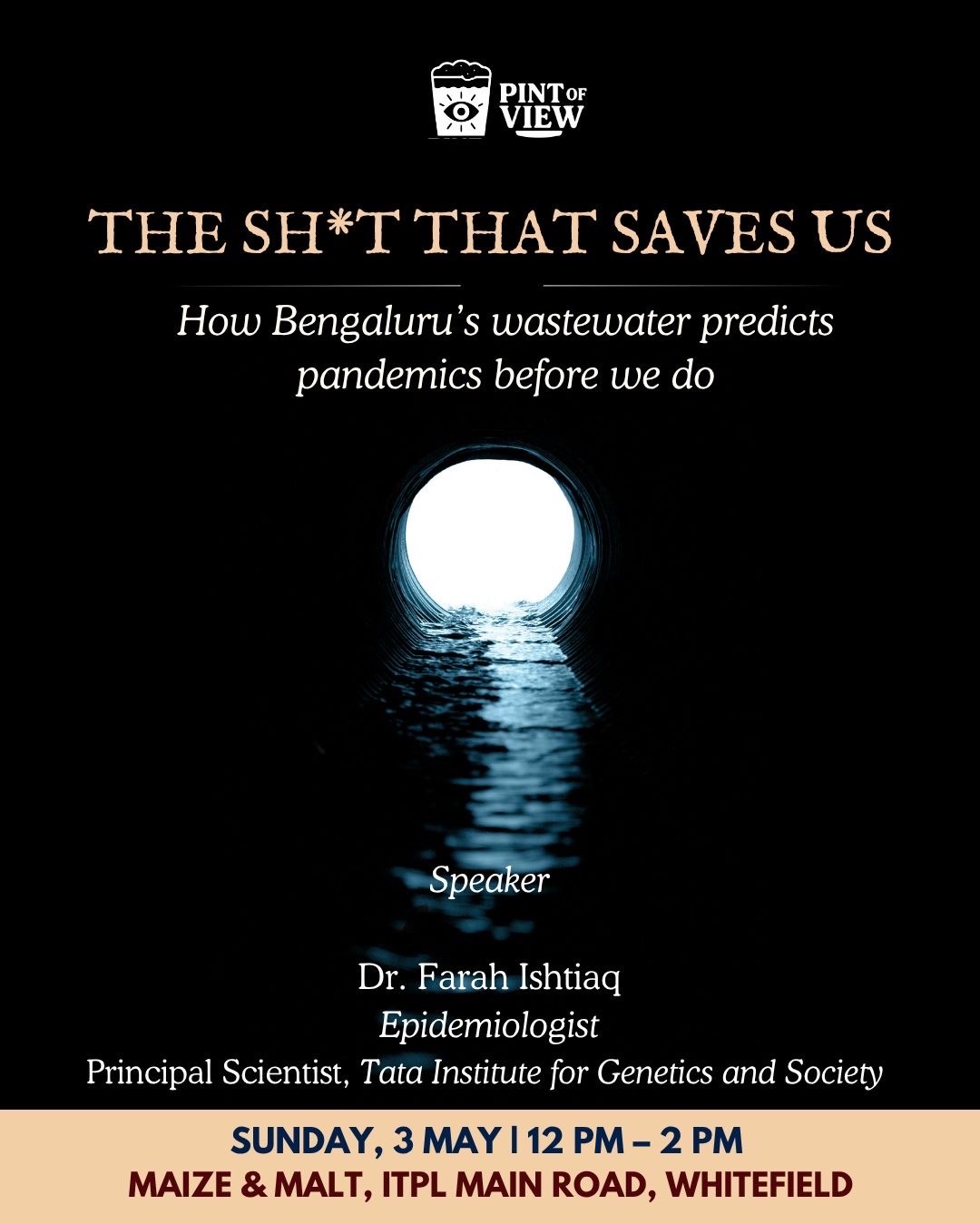
Pint of View (Lecture #60): The Sh*t That Saves Us
About the event
Welcome to Pint of View – Bangalore's first-ever community where classroom-styled lectures meet drinks in pubs and bars.
The COVID-19 pandemic has renewed interest in wastewater-based epidemiology (wastewater environmental surveillance; WES) as a complementary tool for tracking the evolution of the pandemic in many countries. WES is a powerful approach that combines epidemiological data with genomic surveillance to provide insights into changing pathogen diversity and evolution, and to identify zoonotic pathogens of interest.
Using four years of WES data from Bengaluru, I will describe how genomic surveillance has served as an early warning system and demonstrate the correlation between SARS-CoV-2 RNA concentrations in wastewater and clinically diagnosed COVID-19 cases, with wastewater trends appearing 8–14 days earlier than clinical data. Employing a deconvolution matrix, we detected emerging variants of concern up to two months earlier in wastewater samples.
Additionally, the professor will share their experiences with the public health relevance of WES, particularly regarding multi-pathogen targets, examples of the information WES can and cannot currently provide to public health professionals, and how this information can inform public health actions. By combining metagenomic approaches with targeted and unbiased sequencing, our goal is to develop a policy and strategy for monitoring priority pathogens and to use WES as a backbone for addressing water quality issues, especially regarding the potential persistence of bacterial, viral, and protozoan pathogens in recycled water.
Speaker Bio
Farah Ishtiaq is a Principal Scientist at the Tata Institute for Genetics and Society (TIGS), working at the intersection of ecology, genomics, and public health. Her research focuses on disease ecology, environmental surveillance, evolution, and conservation biology, with a strong emphasis on the One Health approach that links human, animal, and environmental health.
She earned her PhD from Aligarh Muslim University in 1999 and has over two decades of international research experience across institutions in India, the United States, and the United Kingdom. Her career includes roles at the Smithsonian Institution, the University of Oxford, the Wildlife Conservation Society (USA), and the Bombay Natural History Society, where she contributed to bird conservation and ecological research.
Her work explores how vector-borne diseases such as malaria and dengue evolve and spread, using tools from genomics and ecology. More recently, she has been involved in wastewater-based epidemiology, studying how pathogens like SARS-CoV-2 can be tracked through sewage as an early warning system for public health.
Ishtiaq has received several prestigious fellowships and grants, including the Wellcome Trust–DBT India Alliance Intermediate Fellowship and funding from the Indian Council of Medical Research for environmental surveillance projects. Her research sits at the crossroads of climate change, biodiversity and infectious disease, predicting how changing environments shape the emergence and transmission of pathogens.
Event Details
- Maize & Malt, Whitefield Main Road
- Sunday, 3 May | 12 PM to 2 PM
What your ticket includes
- 1 complimentary freshly brewed beer or a mocktail
Seating will be on first-come, first-served basis.
What to Expect:
- A 60-minute lecture
- 30–45 minutes of interactive Q&A
- Social mixer and personal Q&As with the lecturer
About Pint of View
Inspired by the successful Lectures on Tap community in the U.S., Pint of View brings this format to India for the first time. It’s where big ideas meet bar tables, and where you enjoy a drink in hand, walking out with a new way of seeing the world.
Book now & develop your own pint of view! 🍻
- Masterclass
- Food & Drink
- Talk / Panel
Photos
FAQs
Terms and conditions
Tickets are non refundable but transferable. You can sell or pass your ticket to someone else. Seating will be on first come, first served basis.