
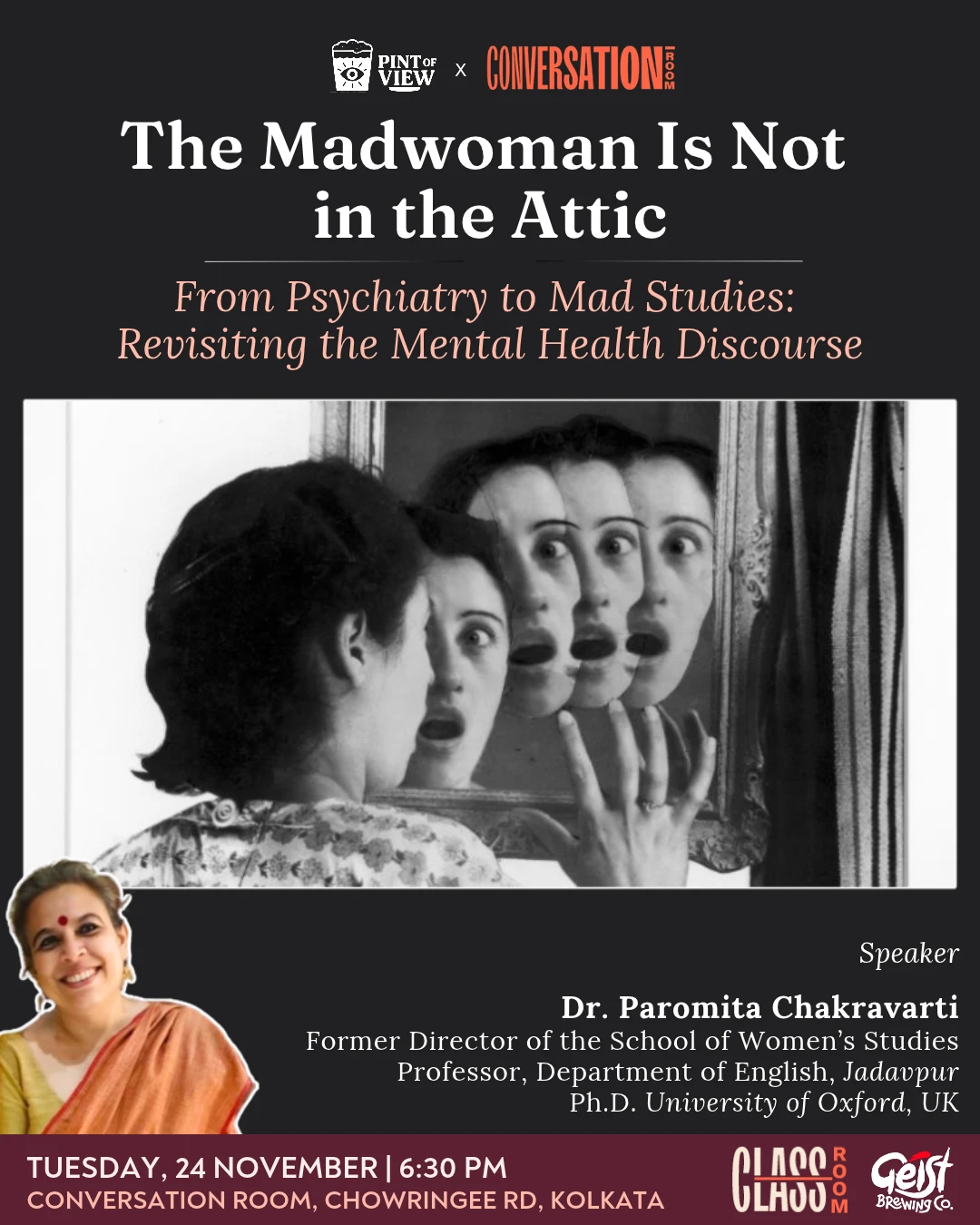
Pint of View Kolkata (Lecture #9): The Madwoman is not in the Attic
About the event
Pint of View is now spiriting up Kolkata! 🍺
About the Lecture
The Madwoman Is Not in the Attic: From Psychiatry to Mad Studies—Revisiting the Mental Health Discourse
Our discursive understanding of mental health is largely framed by the psychological and psychiatric disciplines. These define it in biomedical terms and conceive of mental distress largely in stigmatized terms of disease, disorder or “abnormality”.
Focussing on symptoms, genetics neurochemicals and pharmaceuticals the psychiatric sciences target the individual “patient” or “case” as aberrant and “problematic”, and aim to segregate them from the family and community. Little or no attention is paid to the social, cultural or structural causes or effects of mental suffering. The psychiatric system confers coercive powers on the psychiatrist which include the authority to invalidate the patients’ own accounts of their experiences, override issues of consent and human rights and to enforce incarceration. For these reasons there has been a growing critique of psychiatry and a demand for developing alternate models of understanding the mind and its vulnerabilities.
There have also been attempts to explore other modalities of therapy and recovery which are more socially and culturally rooted and which foreground the experiences of those undergoing distress rather than the essentialist and universalist imposition of a biomedical model.
This lecture would explore the ways in which the dominance of Psychiatry has been challenged in different ways by anti-psychiatry activists, Sociologists and historians of madness, critical psychiatrists, practitioners of alternate therapy as well as by the community of psychiatric survivors or users (a term preferred over “patient” which stresses the disease model) and their allies.
The lecture will trace how these contestations of mainstream Psychiatry has led to the development of “Mad Studies” which exposes the limits of the assertions of scientific validity and professional expertise made by Psychiatry, using instead the much more commonly understood and culturally anchored term “madness”.
Rather than the biomedical template, Mad Studies favours a psycho-social model which foregrounds the experiences of sufferers and their ordinary modes of communicating their difficulties in everyday terms. However, Psychiatry and Mad Studies are two modalities of exploring the mind and its mysteries—they are not exclusive and have different and important insights to offer.
The second part of the lecture will examine through two examples how Mad Studies may expose the fault lines of Psychiatry while providing alternate and fresh approaches to understanding the psyche which are sensitive to social, historical and cultural determinants of mental health. This section will therefore focus on representations and constructions of ideas of madness in cultural expressions which challenge or transcend the categories of psychiatry and offer us new ways of understanding the mind and its discontents.
It will first show how the popular genre of the asylum novel, written by American and British women in the 1950s and 1960s about their experiences of institutionalisation expose the gender bias of what could be called Psychiatric Patriarchy which is less therapeutic and more of an instrument of controlling women’s sexualities and creative ambitions.
Sylvia Plath’s Bell Jar and several other novels and films would be used to illustrate this argument. The talk would close with an exploration of Indian Bhakti
cults which celebrate madness as a form of spiritual liberation to create spaces of freedom and alternative self-expression.
About the Speaker
Dr. Paromita Chakravarti is Professor in the Department of English at Jadavpur University, Kolkata, and has been the Director of the School of Women’s Studies at the university.
She completed her doctoral studies at the University of Oxford on sixteenth-century discourses of madness and their representation in Shakespearean drama. Her teaching and research span Renaissance drama, women’s writing, sexuality and film studies.
Paromita pioneered postgraduate courses in Queer Studies and Women Writing Madness at Jadavpur University. Her work has extensively examined gender, sexuality, women’s education and marginalised identities. She has worked with “Anjali”, an organisation addressing mental health, and advises “Durbar”, a sex workers’ collective.
Her publications include Women Contesting Culture (2012), Shakespeare and Indian Cinemas (2018) and Asian Interventions in Global Shakespeares (2020), alongside several works on gender, culture and society. Her interdisciplinary scholarship brings together literary studies, feminist thought and the social histories of marginalisation.
Event Details
📅 Tuesday, 24 November
🕓 6:30 PM - 8:30 PM
📍 Conversation Room, Chowringhee Road, Kolkata
🍻 Enjoy a complimentary Geist beer on the house
Seating strictly on first come first served basis.
About Pint of View
Pint of View is India's Largest Lecture Community. We brought the lecture in bar format to India and are now expanding across the globe with chapters in 14 cities worldwide. Here, big ideas meet intimate spaces, and you walk in curious and walk out with a sharper lens on the world.
Book now and develop your own pint of view. 🍻
- Masterclass
- Food & Drink
- Talk / Panel
Photos

FAQs
Terms and conditions
One Geist beer included. Additional food & beverages can be ordered on à la carte basis. Feel free to arrive around 6:00 pm to meet fellow attendees and grab a drink or a snack. We begin on time. Tickets are non refundable but transferable. You can sell or pass your ticket to someone else. Seating will be on first come, first served basis. Kids (under 18 year olds) are not allowed at the bar post 6 pm.