
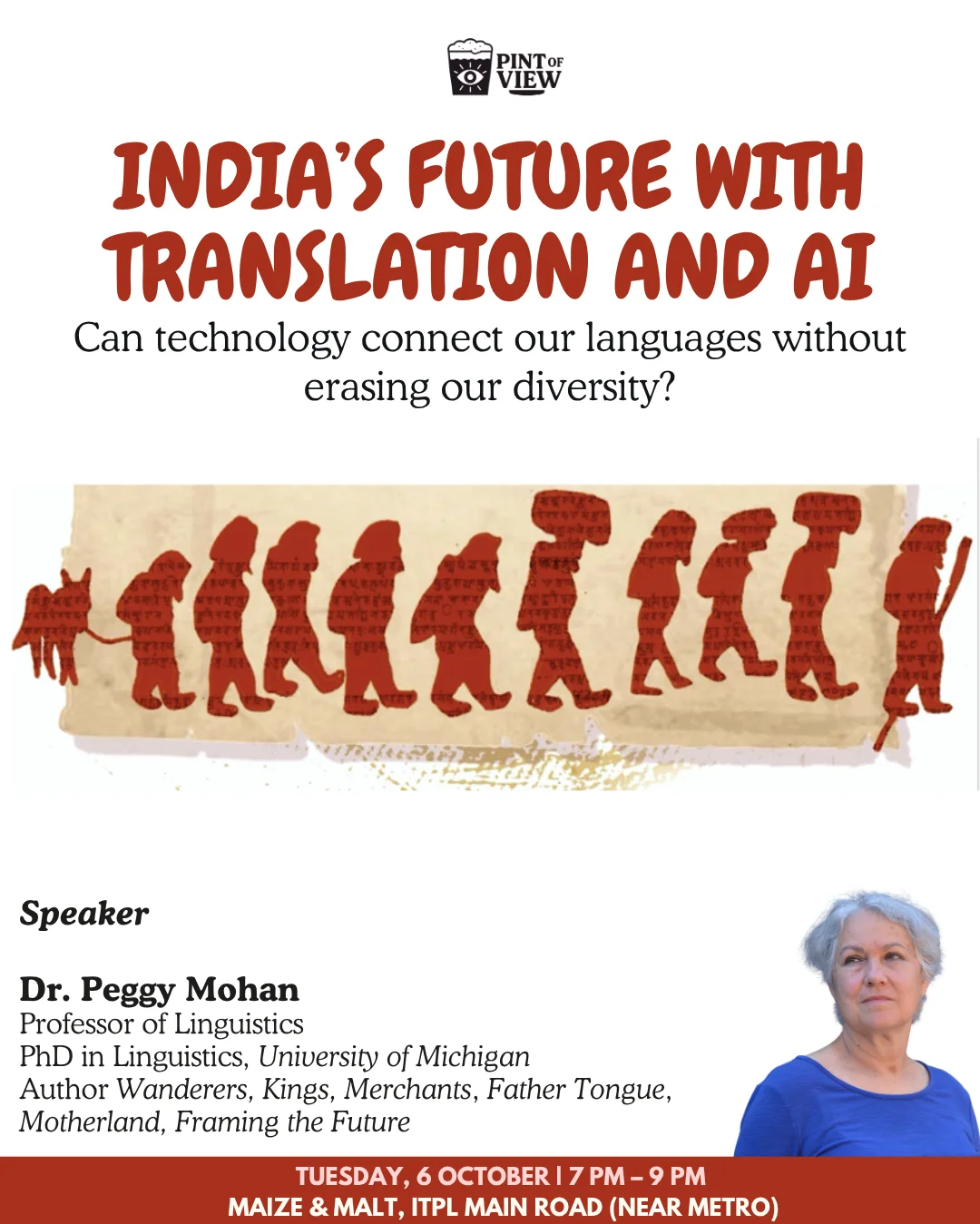
Pint of View (Lecture #109): India’s Future with Translation & AI
About the event
Welcome to Pint of View, Bangalore’s first-ever community where classroom-styled lectures meet drinks in relaxed spaces.
About the Lecture
When one studies the past trajectory of Indian languages, one is tempted to start wondering about the future: in a world of increasing homogeneity, is there a chance that India will find its footing and emerge as a modern technological society, but with its diversity intact?
The history of South Asia shows an early settlement, the first humans out of Africa, followed by a repeating pattern of male-driven migrations beginning in the Bronze Age, migrant men who settled down and had families with local women, leaving a characteristic type of mixture in the languages they spawned. Each influx of migrant men left its stamp on the vocabulary of our languages, but the maternal bedrock of our languages remained constant, so much so that features like word order and notions of grammar outlasted the superficial contributions of the migrant men. Underlying all our modern written languages there is a layer where they still look surprisingly alike.
India is not an English-speaking nation: at least 90 percent of our population is uncomfortable having to operate in English for all its modern and technical activity. But as we approach a multipolar age, where other nations are ‘firing on all cylinders’ and using their human resources to the full, can we afford to keep excluding so much of our population from the concerns of the modern era? Ordinary people’s sudden interest in joining the discussion, and having more written material available in local languages, points to a way forward.
Could one access this common bedrock underpinning our languages and connect them by translation? China was able to connect its ‘dialects’ by having a single logographic writing system that saw beyond vocabulary differences and appealed to a common ‘Chinese’ core. Given that our languages are more typologically similar than our different scripts and vocabularies make them look, could we develop… not a logographic writing system, but a home-grown AI to assist in connecting languages previously in their individual silos through translation? Such an approach would allow us to ‘have it all’: a modern inclusive society that ‘fires on all cylinders’, where all our major written languages would ‘talk to each other’, without our diversity being lost.
About the Speaker
Dr. Peggy Mohan was born in Trinidad, West Indies. She studied linguistics at the University of the West Indies, and completed her PhD in linguistics from the University of Michigan in 1978.
She has taught linguistics at Howard University, Washington D.C., Jawaharlal Nehru University and Ashoka University, and mass communications at Jamia Millia Islamia, New Delhi.
She is the author of three novels, Jahajin, The Youngest Suspect and Walk in C Minor, and the non-fiction books Wanderers, Kings, Merchants, (Penguin Random House 2021) which won the Mathrubhumi Book of the Year Award, and Father Tongue, Motherland (Penguin Random House 2025) which won the Sarvepalli Radhakrishnan Award for Non-Fiction.
She also has another book on language in India, Framing The Future, which will be released by Penguin Random House in October 2026.
She lives in New Delhi and is in Bangalore for a short while, during which she’s also giving this lecture.
Event Details
📅 Tuesday, 6 October
🕛 7 PM – 9 PM
📍 Maize & Malt, ITPL Main Road, Bangalore [4 mins from metro]
Your ticket includes:
• 1 complimentary freshly brewed beer or mocktail
• First-come, first-served seating
About Pint of View
Pint of View is India's Largest Lecture Community. We brought the lecture in bar format to India and are now expanding across the globe with chapters in 14 cities worldwide. Here, big ideas meet intimate spaces, and you walk in curious and walk out with a sharper lens on the world.
Book now and develop your own pint of view. 🍻
- Masterclass
- Food & Drink
- Talk / Panel
Photos
FAQs
Terms and conditions
Tickets are non refundable but transferable. You can sell or pass your ticket to someone else. Seating will be on first come, first served basis.